
Last Updated on: Aug 17, 2026
Not every kitchen has a dishwasher, and even kitchens that do still end up with a pile of things that cannot go in it: the good knife, a wooden spoon, a nonstick pan, a travel mug, a baby bottle. That is the job of the dish rack. It is one of the least exciting things in a kitchen, and also one of the most used.
A bad rack is a daily annoyance. It tips when you add a heavy pot, leaves a puddle on the counter, grows a pink film in the drip tray, and never quite fits the space next to the sink. A good one holds a full load, drains into the sink, and cleans up in a minute. The main choice is where it sits: on the counter, over the sink, or rolled up and tucked away. Here is how to pick.
Top Dish Racks
What We'll Cover
Start with your space
Measure before you shop. For a countertop rack, measure the depth of the counter and the space next to the sink, and check the height under any upper cabinets if you are looking at a two-tier model. For an over-the-sink rack, measure the width of the sink from outer edge to outer edge, and note where the faucet sits. Many over-sink racks adjust to a range of widths, so make sure your sink falls inside that range.
Then think about volume. A household that washes everything by hand needs room for a full dinner's worth of plates, glasses, and pots. A household with a dishwasher may only need space for a few hand-wash items a day.
The main styles
Countertop racks
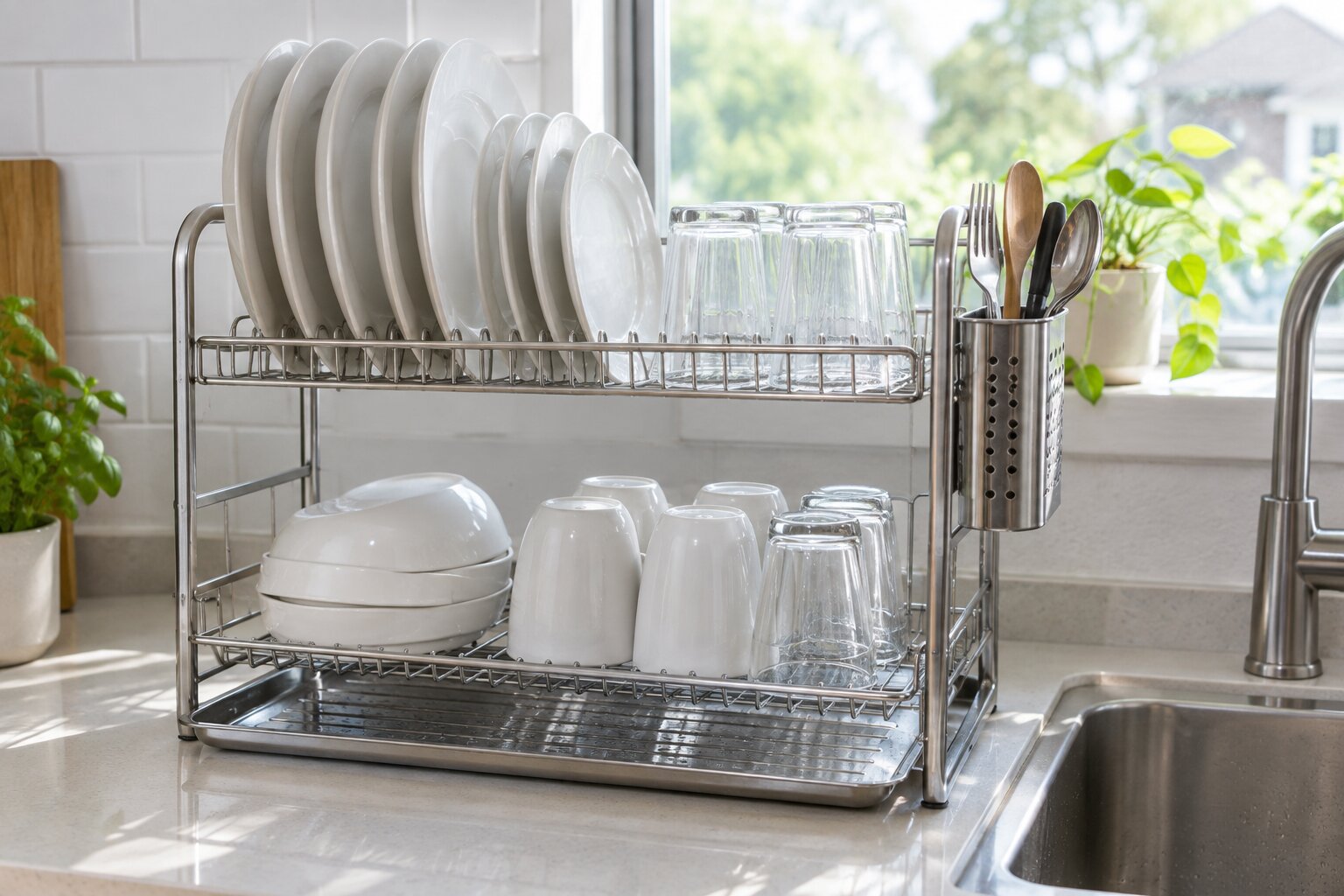
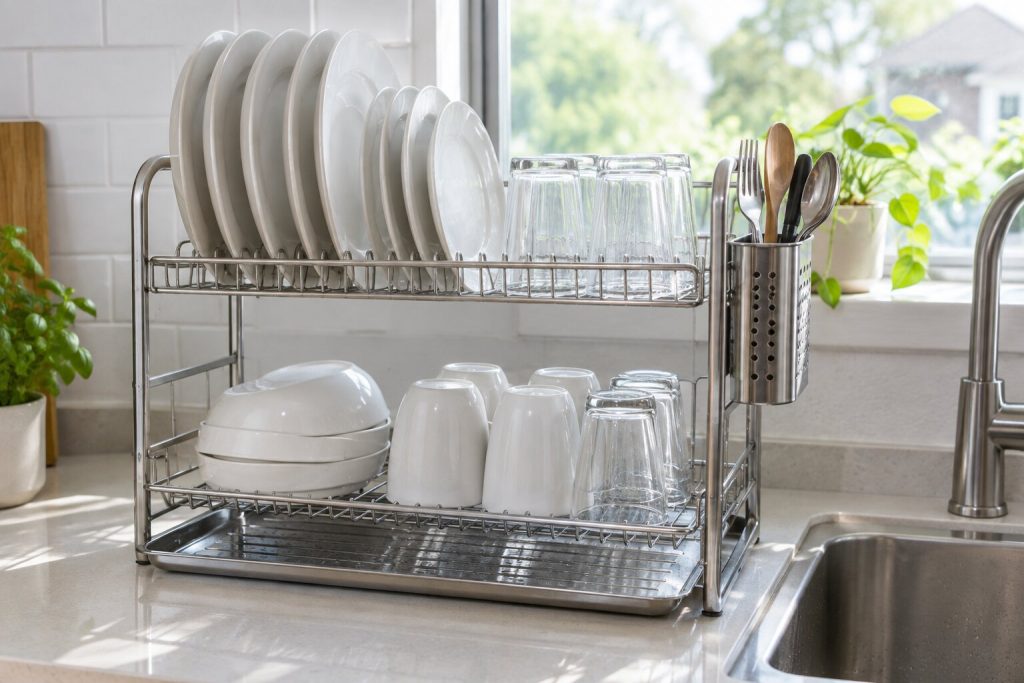
The classic dish rack sits on the counter with a drip tray or drainboard underneath. The best ones have a sloped drainboard or a spout that points into the sink, so water runs away instead of sitting in the tray. Two-tier racks stack plates on top and bowls, cups, and pots below, which doubles capacity without taking more counter space.
Over-the-sink racks
These racks stand on legs or rails that span the sink, so dishes drip straight into the basin. They free up the counter and often include shelves for soap, sponges, and cutting boards. They work best in kitchens with a deep or double sink and a faucet that does not get in the way.
Roll-up racks
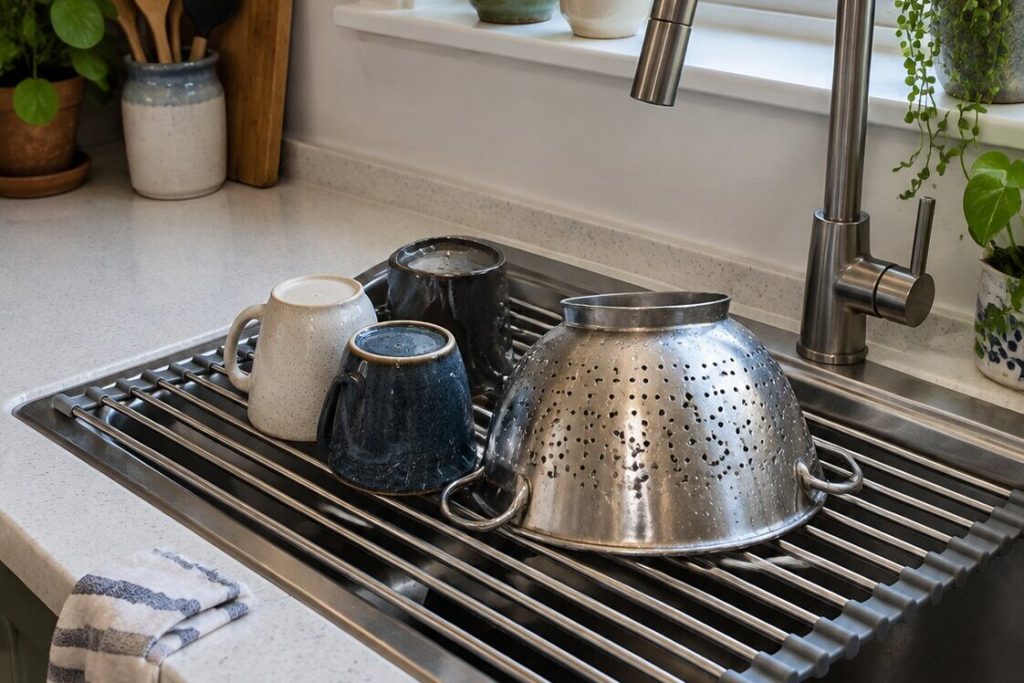
A roll-up rack is a mat of steel rods wrapped in silicone. Lay it across the sink to dry a few mugs, rinse produce, or rest a hot pot, then roll it up and put it in a drawer. It is the easiest option for small kitchens, but it holds far less than a full rack.
Collapsible racks
Collapsible racks fold flat when not in use. They are handy in RVs, dorms, and apartments where every inch of counter counts.
What to look for
Rust-resistant material. Stainless steel and coated steel last longest. Cheap coated wire can chip, and then it rusts. Look for rust-resistant or 304 stainless steel if you want a rack that lasts for years.
Drainage. A sloped drainboard or an adjustable spout moves water into the sink. A flat tray without a drain has to be emptied by hand.
Easy to clean. Removable trays and utensil cups are much easier to wash. Fewer tight corners mean fewer places for grime to build up.
Stability. Non-slip feet keep the rack in place on smooth counters, and a solid frame keeps it from tipping when you add heavy pots.
Keep the rack clean
A dish rack stays wet much of the day, and damp spots are where bacteria and mildew grow. The USDA recommends a two-step routine for the kitchen sink and surfaces: clean first with warm, soapy water, then sanitize. It notes that an easy homemade sanitizer is 1 tablespoon of liquid chlorine bleach per gallon of water, or you can use a commercial kitchen sanitizer. Cleaning first matters, because sanitizing works best on a surface that has already been washed. Doing this for the sink area regularly, and giving the rack and tray a scrub while you are at it, keeps the whole drying zone fresh.
The USDA also suggests wiping surfaces with single-use or paper towels, and says kitchen towels used for cleaning should be washed often. Letting dishes air dry in a rack avoids reusing the same damp towel on clean plates.
Empty the drip tray every day or two, and wash the rack and tray once a week. If you see a pink or black film, that is a sign it needs a more thorough scrub.
Loading a rack so everything dries
How you load the rack makes a big difference in how fast things dry. Stand plates on edge in the slots, facing the same way, so air can move between them. Put cups and glasses upside down, but at a slight angle if the rack allows it, so water does not pool on the rim. Bowls go on the lower tier or at the back, tipped so they drain.
Put utensils in the cup handles down, except for sharp knives, which are safer point down or laid flat in a separate spot. Pots and pans are best placed last, on top or leaned against the frame, so they do not crush glasses underneath. If you wash by hand, the FDA recommends washing dishes, utensils, and cutting boards with hot soapy water after preparing each food item, so give items that touched raw meat an especially good scrub before they go in the rack.
Countertop racks
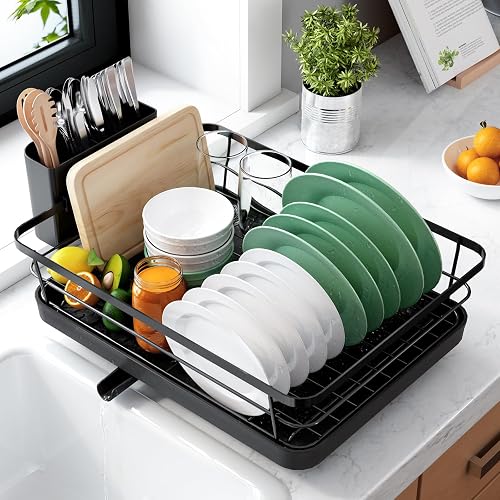
COMPACT VOLUME: Kitsure dish rack is suitable for kitchens with limited space. The bottom layer measures only 12''W x 15.5''L and the overall height is 5". The rack is capable of holding 10 plates ...
Kitsure's compact rack is the top seller in its category and a good fit for small kitchens. The base measures 12 by 15.5 inches, and it stands only 5 inches tall, yet it holds 10 plates plus bowls and glasses. The frame is rust-proof metal over a plastic drainboard, and the whole thing rinses clean under the tap.
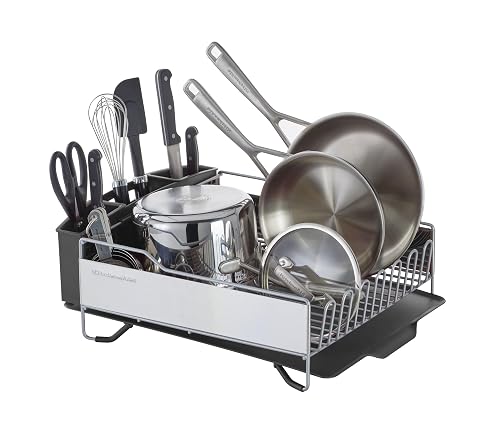
SPACIOUS DESIGN FOR LARGE LOADS: This full size dish rack offers ample space for plates, mugs, glasses, bowls, utensils, and even larger items like pots and pans. Please refer to product dimensions...
KitchenAid's full-size rack is built for big loads, with room for plates, mugs, glasses, bowls, utensils, and even pots and pans. It uses heavy-duty satin-coated steel wire to resist rust, an angled drain board, and soft non-slip feet that keep it steady.
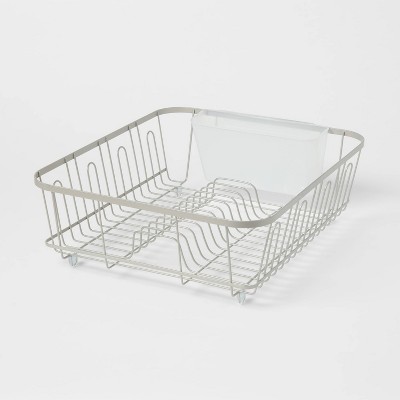
At Target, the Brightroom large steel dish drainer is a simple freestanding option in brushed nickel, with dish slots, side slots for cups, and an attached plastic utensil holder.
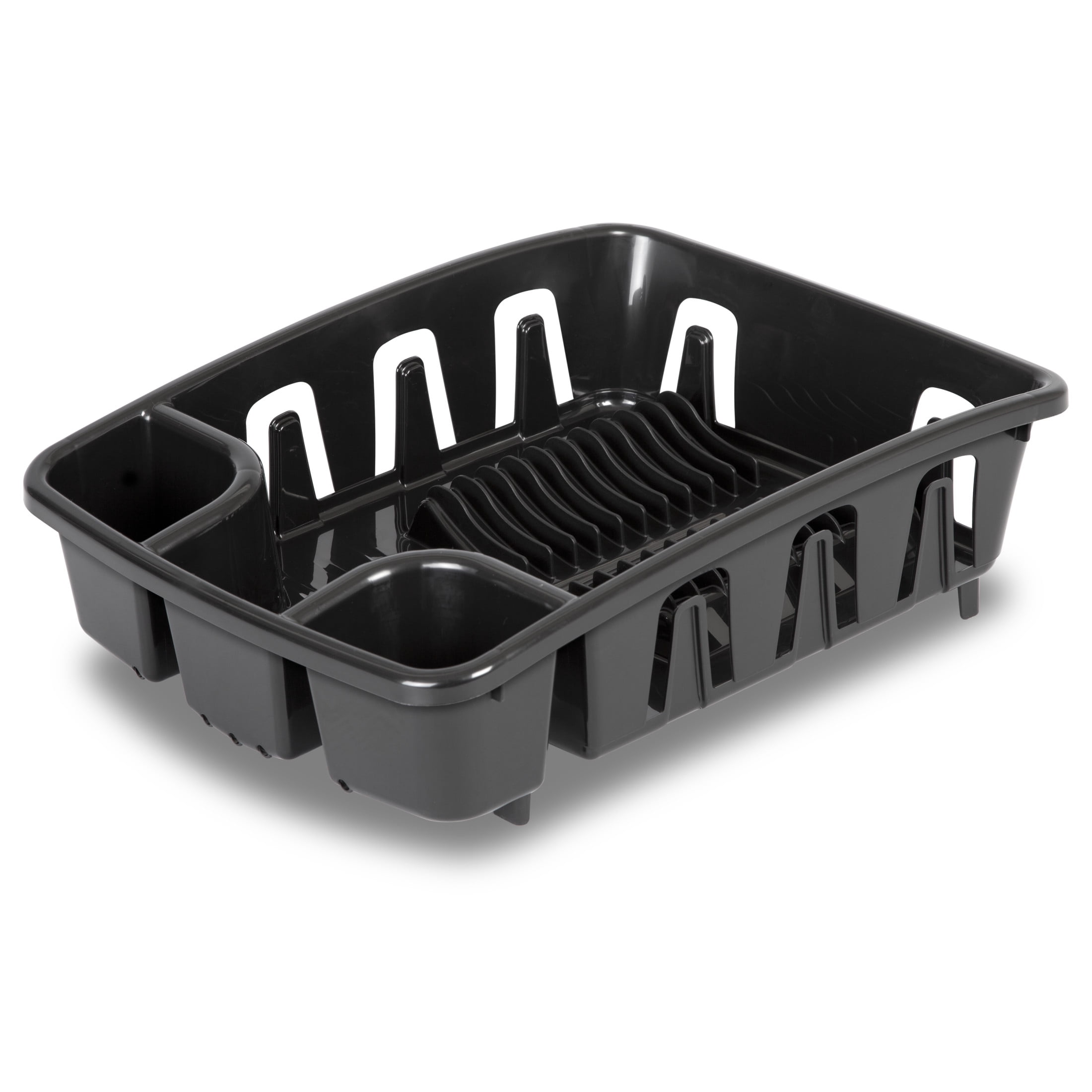
If you want the rack and drainboard in one piece, Walmart carries the Sterilite DrainRack. Its base is sloped so water runs toward the sink, and being plastic, it will not rust.
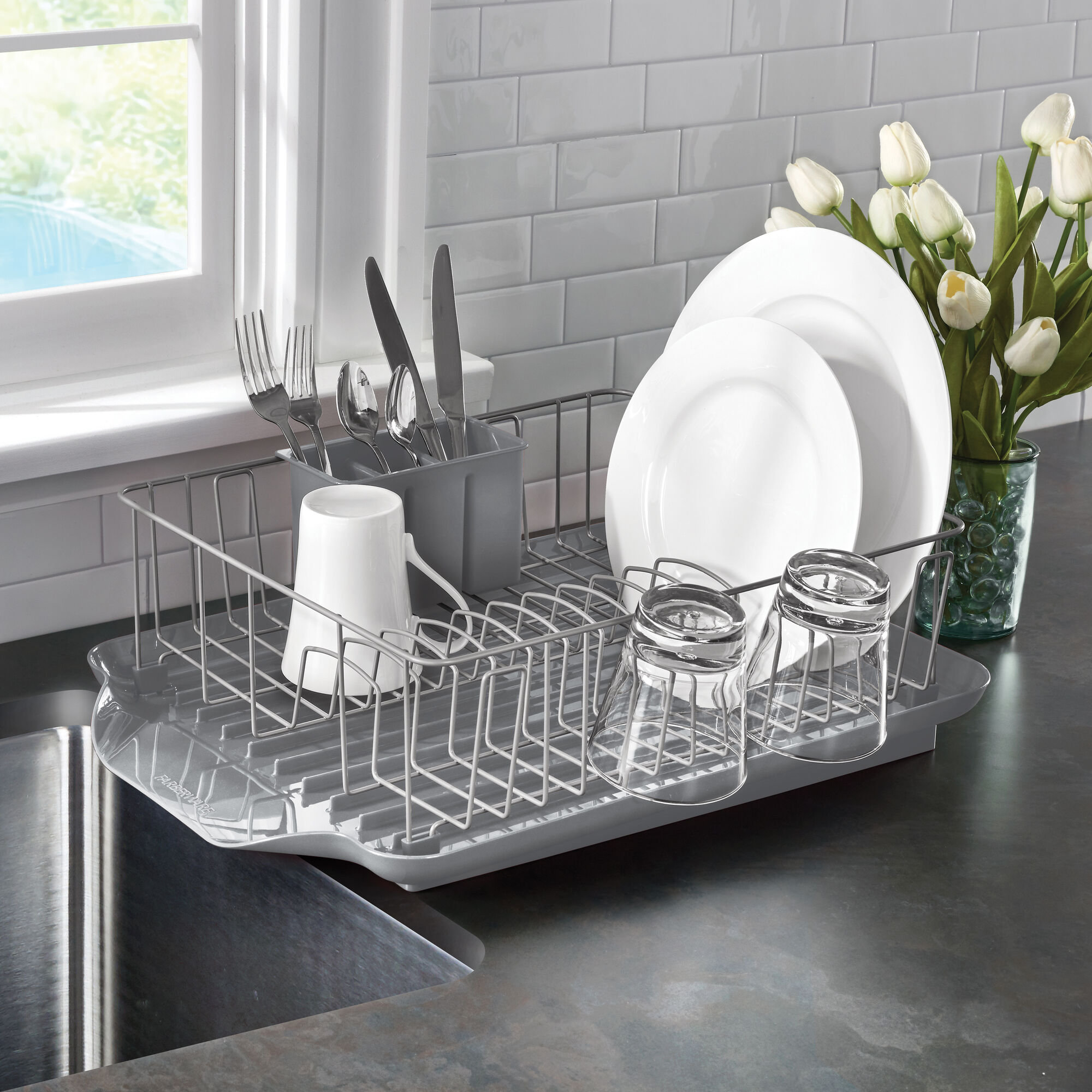
Wayfair sells a Farberware three-piece dish rack set with a rust-resistant finish. A set like this lets you split the rack, drainboard, and utensil holder around your counter instead of needing one big footprint.
Over-the-sink and in-sink racks
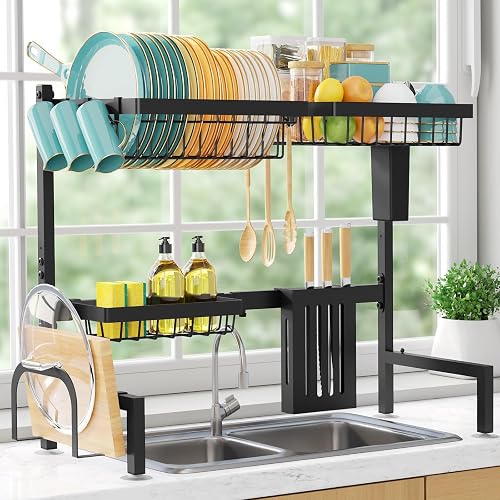
LARGE CAPACITY: The Sakugi dish rack for kitchen counter boasts an impressive capacity that can accommodate a variety of tableware and cleaning supplies, including bowls, dishes, knives, wine glass...
Sakugi's two-tier over-the-sink rack is a full storage station. It adjusts from 30.0 to 33.9 inches wide to fit most sinks and has room for bowls, plates, knives, wine glasses, cutting boards, sponges, and brushes. It is a good choice when you want the counter completely clear.
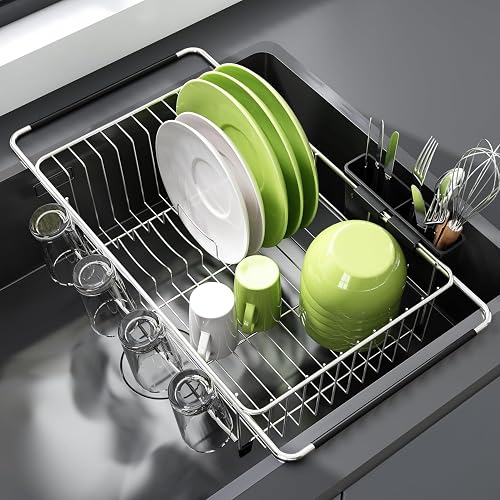
🔄Space Saving Dual Mode: This dish drying rack expands for over sink or in sink. Create extra workspace in small kitchens, eliminates countertop clutter while dishes dry efficiently
📏Universal Sink...
JASIWAY's rack works two ways, either inside the sink or across it. Its support bars extend from 15.5 to 23.2 inches without tools, so it can fit both single and compact double sinks. It includes a cup and utensil holder. Measure your sink first, as the maker recommends.
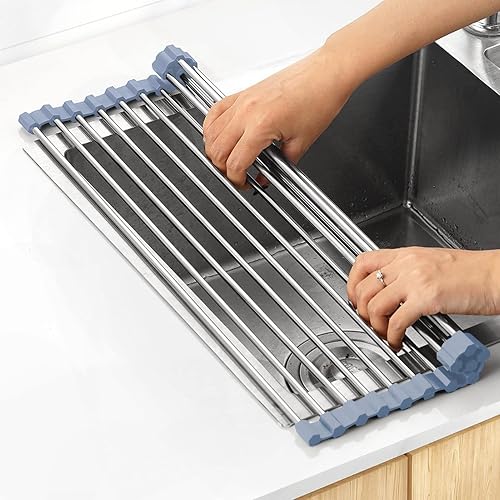
PRODUCT SIZE: The dimension of our kitchen sink organizers is 17.5" (L) x 11.8" (W). Suitable for kitchen sink, undermount kitchen sink, rv sink, camping sink and other outdoor kitchen sinks, etc. ...
MECHEER's roll-up rack measures 17.5 by 11.8 inches and works on kitchen sinks, undermount sinks, RV sinks, and camping sinks. Use it to dry dishes, rinse fruit and vegetables, or thaw food, then roll it up and store it.
For small spaces
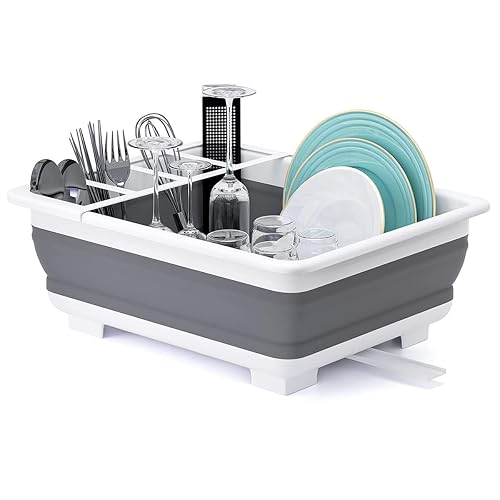
【Food Grade Material】Made from eco-friendly PP+TPR material that is BPA Free and Food-Grade. The flexible material allows the dish strainers for kitchen counter to collapse flat for easy space-savi...
THANSTAR's collapsible rack folds flat when you are done. It is made of BPA-free, food-grade PP and TPR, has a separate space for utensils, and its soft material will not scratch dishes. It is a smart pick for dorms, RVs, and tiny apartment kitchens.
Which one to choose
For most kitchens, a countertop rack with a sloped drainboard and a removable tray is the easiest daily choice. If your counter is tight but your sink is wide, an over-the-sink rack clears space and drips right into the basin. For only a few hand-wash items, a roll-up rack is cheap and disappears into a drawer. Whatever you choose, measure first, empty the tray often, and give the rack a good wash each week.
The responses below are not provided, commissioned, reviewed, approved, or otherwise endorsed by any financial entity or advertiser. It is not the advertiser’s responsibility to ensure all posts and/or questions are answered.
Tip for anyone with a small counter: measure the depth from the backsplash to the counter edge too, not just the width. A lot of racks list length and width but the drainboard spout can stick out past the sink edge.